Sunday, November 16, 2003

Temple of Anahita In Iran


Anahita, or Nahid, was a major deity in the pre-Islamic Iran. She was the protector of water and the goddess of beauty, fertility and fecundity. During the Parthian period Anahita's worship become so popular and venerable that Tiridates I was crowned in her temple. The worship of Anahita in the Kangavar region was particularly so popular that in the first half of the first century AD the Greek geographer, Isidore of Charax, was the first to mention the Temple in his book by the name of Konkobar, refering to it as the "Temple of Artemis".
The temple is located in Kangavar, a small town of great antiquity lying halfway between Hamedan and Kermanshah. Architecture of this temple coincides with palaces and temples built during the Achaemenian period, 550 BC to 330 BC, in western Iran, like Persepolis and palace of Darius in Susa. Large pieces of stone are cut and shaped into blocks of rock. They are placed on top of each other; their shape usually causes them to interlock to form a wall or platform by a mountainside. The colums themselves have an Ionice shape which was vastly used by Greeks in structures like Parthenon ( im not sure who copeid who).
According to classic historians, the temple of Anahita at Ecbatana was a vast palace, four-fifths of a mile in circumference, built of cedar or cypress. In all of it, not a single plank or column stood but was covered by plates of silver or gold. Every tile of the floors was made of silver, and the whole building was apparently faced with bricks of silver and gold. It was first plundered by Alexander in 335 BC, then further stripped during the reigns of Antigonus (BC 325-301) and Seleucus Nicator (BC 312-280).
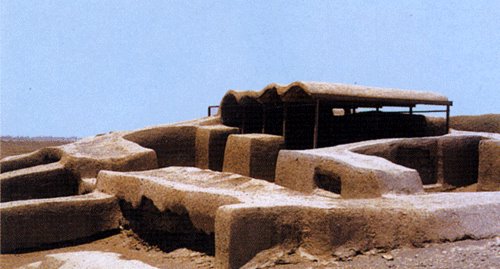
The site has been dated to the Parthian period based on a number of archaeological pieces of evidence such as pottery, carved stones, and brials typical of the period. Today, houses and streets have been built on its surface and only part of the temple has remained intact being adjacent to the Imamzadeh Mosque.

Map of the location of Kangavar in Iran:
http://www.derafsh-kaviyani.com/jpg/anahita/anahita2.jpg
Ancient Drawings:
http://www.derafsh-kaviyani.com/jpg/anahita/anahita4s.jpg
http://www.derafsh-kaviyani.com/jpg/anahita/anahita15.jpg
How it looks Today:
http://www.derafsh-kaviyani.com/jpg/anahita/anahita5.jpg
http://www.derafsh-kaviyani.com/jpg/anahita/anahita8.jpg
http://www.derafsh-kaviyani.com/jpg/anahita/anahita11.jpg
http://www.derafsh-kaviyani.com/jpg/anahita/anahita3.jpg
http://www.vohuman.org/SlideShow/Anahita%20Kangavar/Anahita01.jpg
http://www.vohuman.org/SlideShow/Anahita%20Kangavar/Anahita03.jpg

The Epic of Gilgamesh

The first Iranian epic and perhaps the first epic ever writen is gilgamesh which is composed of several Summerian tales combined together to creat a masterpiece more than four thousand years ago. A Semitic Akkadian version was found in the archives of the Hittite capital at Boghazkoy in Anatolia. It was also translated into Hittite and Hurrian, and several Akkadian texts were found in Ashurbanipal's library at Nineveh from the seventh century BC. Gilgamesh is introduced as one knowing all things and countries including mysteries and secrets who went on a long journey and had his story engraved on stone. He was endowed with beauty by the sun god Shamash and with strength and courage by the storm god Adad, making him two-thirds god and one-third man. The seven sages laid the foundations, and he built the walls and temples of Uruk for Eanna, the heavenly Anu, and the love goddess Ishtar. Gilgamesh ruled Uruk so powerfully that his arrogance was resented, for he enjoyed any virgin or wife that he wanted. The gods heard the people's complaints and decide to create his equal to challenge him. So the goddess of creation produces Enkidu, who lives with wild animals (greeks have a goddess, represented with the name Artimis who lived with animals). One day a trapper encounters the one who has filled in his pits and torn out his traps. The trapper's father suggests that he get Gilgamesh to give his son a woman to tame Enkidu, and he does. When she sees Enkidu in the hills, she strips herself naked and teaches him her woman's art. Enkidu lays with her for a week.When Enkidu goes back to the animals, he is weaker; they run away from him. The woman says that he is wise and has become like a god. Why should he live with animals? She offers to take him to the temples of Anu and Ishtar in Uruk, where he could challenge Gilgamesh. Meanwhile a dream came to Gilgamesh of a star falling from heaven leaving a meteor so heavy he could not lift it, and his mother Ninsun explains that this was a strong friend he would meet. In another dream Gilgamesh found in Uruk an ax he loved like a woman, and Ninsun interprets that this brave man would rescue him. When Enkidu arrives in Uruk, Gilgamesh is about to exercise his privilege of being the first to sleep with a bride. But Enkidu blocks his way, and they fight like two bulls locked together. Gilgamesh throws Enkidu down, and then in mutual respect for each other's strength they become friends. They decide to confront the monster Humbaba, who guards the cedars in the sacred forest. Gilgamesh prays to the sun god Shamash for protection and receives an amulet from his mother. After the counselors of Uruk ask Enkidu to bring their king back safely, they set out on the long journey. Entering the forest gate, Gilgamesh dreams that a mountain fell on him, but he was saved by a beautiful light. Then Enkidu has an ominous dream of a rainstorm. When Gilgamesh chops down a cedar with the ax, Humbaba hears the sound. Knowing the monster, Enkidu is afraid; but Gilgamesh encourages him. Calling on Shamash, Gilgamesh fells seven cedars, and each time Humbaba roars louder. When the two heroes reach Humbaba, he pleads with Gilgamesh for mercy, offering to serve him. Gilgamesh is moved, but Enkidu convinces him to kill the monster; so they cut off his head. Gilgamesh cleans himself up and is asked by the divine Ishtar to be her husband, but he scorns her for having been faithless to so many lovers (in Greek mythology too, it is considered a danger for a mortal man to marry a Goddess). Enraged Ishtar retreats to heaven and asks her father Anu to create a bull of heaven to torment the earth with a famine. The bull charges Enkidu, and he seizes it by the horns so that Gilgamesh can kill it with his sword. Ishtar curses them, but Enkidu defiantly tears out the bull's right thigh and throws it in her face. Enkidu then dreams that the gods have decided that one of them must die for having killed Humbaba and the bull of heaven. Soon Enkidu gets sick and dies. Gilgamesh mourns for him for seven days until a worm appears in his nose. In despair at the death of his friend and realizing now that he must die too, Gilgamesh decides to find Utnapisthtim, who has lived in Dilmun since before the flood. Coming to a gate guarded by scorpion men, Gilgamesh is allowed to pass where no human has ever gone. Passing through darkness, he enters a garden with bushes like gems. The sun-god tells him that he will never find eternal life. Gilgamesh comes to a woman of wine, who asks him why he is searching for the wind. He explains that he is afraid of death, and she suggests that he eat, drink, dance, and enjoy life. He only asks the way to Utnapishtim, and she tells him that he must take the ferry of Uranabi across the ocean. Making Gilgamesh cut six score poles so that his hands won't touch the deadly water, Urshanabi agrees to take him. Finally arriving, Gilgamesh asks his question of Utnapishtim, but he declares there is no permanence. When Gilgamesh wonders how he has lived so long, Utnapishtim reveals a secret of the gods, the story of the deluge. Perturbed by the clamor of humans, the gods decided to let loose a flood on them, but Ea,(mother of Zues in Greek mythology),warned Utnapishtim to build a large boat and load it with supplies and animals. After the boat was ready, the storm came. The boat weathered the deluge and rested on a mountain. Sending out a dove, it came back, as did a swallow, but then a crow was released and did not return. Enlil was angry that a human had survived, but Ea suggested that he should punish sin and transgressions, but not with a flood. Utnapishtim, though a mortal, was allowed to live in the distance. Utnapishtim challenges Gilgamesh to stay awake for a week, but instead he falls asleep for that long, which is proved to him by the decaying seven loaves of bread baked each day by Utnapishtim's wife. Utnapishtim does offer Gilgamesh an herb, which eaten, will bring youth back. Gilgamesh dives underwater to get it, but on his way back to Uruk a serpent steals it from him, eats it, and sheds its skin. Gilgamesh returns to Uruk and must realize that he too is not exempt from death.
One can imagine the influence of such an archetypal story. Gilgamesh represents the achievements of mankind, who now wonders about death. His arrogance is criticized, and the primordial custom of the dominant male being allowed sexual license seems to be a throwback from our pre-ethical evolution as primates. Dreams are perceived to be symbolic guides and often prophetic. A woman, his mother, seems to be most skilled at interpreting them. Another strong male is needed to challenge a strong male, but female charms are able to tame him. The shift from living in the wild is accomplished by sexual lovemaking, which leads Enkidu to civilization after he is no longer one with the animals.

To read the Tablets go to:
http://www.ancienttexts.org/library/mesopotamian/gilgamesh/


Sunday, October 26, 2003

Status of Women In Ancient Iran

One of the sources for learning about the status of women in ancient iran is from Avesta, the holy book of Zorastrians. In Avesta women are shown to share the responsibilities with men. Men and women are equally praised for their deeds in Avesta. Zarathushtra in his advice to parents recommends that they should facilitate both the sons and daughter to acquire knowledge. Every where we see that Zarathushtra mentions mother and father men and women son and daughter and he does not differentiate between sexes.
In the wedding ceremony prayer recited by the priest, husband and wife are equally made responsible for all decision and actions to be taken.
It is worth noting that with the passage of time changes were introduced to the disadvantage of women. Most of which happened due to the influence of the Semitic race on the Aryan race.
In other ancient countries except Egypt women were seen as a child-producing slave. The Assyrians who were always at war needed men to fight these wars and they expected women to produce as many recruits as possible for the army. Girls were accepted in marriage after receiving money. The husband could sell his wife in Assyria and in old age she could be send away from the house that she had lived all her life. Women could not ask for divorce but men could just divorce by making a statement to that effect. If a woman would make such a statement she would to thrown into the river. If a woman did not bear a child she would be send away while if a man could not produce a baby women had no such right.
Among Chinese it was believed that boys were created by God while girls were created by the Devil. Baby girls were sold as slaves and if there were no buyers they were drowned in the river. Husbands could sell their wives or kill them. Girls were used as sacrifice to the gods.
In India during the Vedic period women were treated as equals but after that they were treated worse than animals. On the death of her husband she had to be burned alive in the same pyre that burned her husband. Like in Arabia and China girls could be killed.
In Arabia girls were buried alive, men would give away their wife in gamble. In Rome women were considered as troublemakers and were only used to create more soldiers to meet the needs of their constant war. A Roman could sell his wives just like he sold his slaves. In Greece women were treated like goods. Aristotle rated women next to slaves and below men. Plato considered men to be above women but gave her the right to conduct the affairs in the house and if a woman had the ability he thought she should have the right to even rule.
In Iran we see that women were rulers and if at the time of the death of the king the prince were a child the mother would rule till the son became an adult, Queen Homa mother of king Ardeshir was one such example. Women ruled Iran during different periods in History, Pourandokht and Azarmidokht are examples of successive queens who ruled Iran. Women in Iran lost their status when Iran lost its power to Arabs.
In Egypt women were respected and shared power and old ladies were given special respected. Women were also traders in Egypt and attend the court and parties in their best attire and they also had religious powers.
Women in ancient Iran compared to women in other nations had great respect and were highly placed in society. They even participated in sports like horse racing, polo, archery etc. After the attack of the Arabs they lost all their personal and social rights and were treated in par with women in other parts of the world. However, lately we have been blessed by a number of Iranian women activists, one of whom was Shirin Ebadi who won this years Nobel Peace Prize as a results of her efforts to acumplish democracy and human rights for the peaple of Iran.
Pictures of Shirin Ebadi :
http://www.iranianchildren.org/Ebadi/pebadi04.jpg
http://us.news2.yimg.com/us.yimg.com/p/ap/20031215/capt.par10212151445.france_ebadi_par102.jpg
http://us.news1.yimg.com/us.yimg.com/p/rids/20031211/i/r3943982929.jpghttp://www.iranianchildren.org/Ebadi/pebadi15.jpg
http://www.iranianchildren.org/Ebadi02/shirin02.jpg
http://www.iranianchildren.org/Ebadi02/shirin13.jpg
http://www.iranianchildren.org/Ebadi02/shirin25.jpg

Friday, October 24, 2003

The Burnt city


One of the most ancient sites in Iran is The Burnt City, located in the Eastern part of the country, South of Zabol in the region of Sistan. The unexpected appearance & the quick disappearance of the city baffled experts for years. According to the excavations and researches, the Burned City has come to be known as one of the most important proofs of the independence of the eastern part of Iran from Mesopotamia. Judging by the artifacts recovered in the area, the inhabitants seem to have been a race of intelligent people who were both farmers & builders of various crafts. So far no military ware has been discovered, suggesting the peaceful nature of the residents. What is really strange about burnt city is the fact that it has no connection to any other old civilisations in the area, as if it completely came from elsewhere. One of the prominent relics found in the Burned City is a skull that according to the anthropological studies, is the first evidence of brain surgeries in prehistoric Iran. Recent archaeological studies, has led into new discoveries in the architectural style of this city's buildings as well as the finding the biggest pre- historic clothe collection in the Middle East. Even more recently, Burnt City has been identified as one of the most rare ancient cities in which women were in charge of their family's financial affairs!

Pictures:

http://www.iccim.org/English/Iran/sistan/images/BurntCity.gif

Dinosaur Footprints in Birjand

In the year 2000, forty footprints of dinosaurs, , were discovered on the sedimentary rocks in the north of the city of Birjand. These footprints belong to about 50 million years ago Ali Hassandbady the leader of the archeological group said: “This area was swampy on that time and rocks had plenty of organic materials. The erosion of the upper layer caused the footprints to surf. These footprints belong to the third eon of geology and indicates that this area was suitable for the movement of dinosaurs”. Preliminary studies show a complete harmony between the footprints. They are elliptical and their size is about 42x26 to 12x8 centimeter. Dinosaurs moved in groups and their direction of movement was east to west. The species of the dinosaurs has not yet determined. Also a joint Iranian-Brazilian team discovered a dinosaur tooth and some indetermined bone fragments in Northern Kerman. The discoveries are from red bed attributed to Bidou Formation (Late Jurassic/ Early Cretaceous) in Ab Bid Syncline.

Pictures:
http://216.247.17.15/p/musum/images/12.gif
http://216.247.17.15/p/musum/images/14.gif
http://216.247.17.15/p/musum/images/15.gif
http://216.247.17.15/p/musum/images/13.gif

Sunday, October 19, 2003

Roots and Branches of Farsi Language

Some languages have been grouped as Indo-European and a branch of it is called Indo-Iranian. The Indo-Iranian is again divided into two - The Iranian languages being one of them.The Iranian language is again divided into three:

-Old Iranian language
-Middle Iranian Language
-Modern Iranian language


Old Iranian language
The median language is one of the Old Iranian languages.This was the language of the mads,which was spoken in Central and Western Iran around 835 BCE. The Greek language has borrowed many words from this language. The stone carvings of the Hakhamaneshinians have words from this language.
Old Persian was the state language of the Hakhamaneshinians and is related to Avesta and Sanskrit. Two samples of the language are the stone carvings of Daruish and Ardeshir-lll. The carvings at Bisotum in Hamadan have about 500 words of Old Persian.
Avesta was the language of the East and North Eastern Iran. And the religious books at different periods were written in this language. Gathas are the most ancient form of this language.

Middle Iranian language
These languages were steadily formed with the change in political power. It includes Parthian Pahlavi and Hakahmaneshian Pahlavi. Parthian Pahlavi was the language of the Parthian who lived in the North East of Iran and have left behind some stone tablets in Parthian script, which is derived from the Aarami script. Some of these writings have been found in Ooramaneh in Kurdistan. At Naksh Rostam and Hajiabad of Fars the writings of Shahpour-I are an example of this language. So also, is the message of Nersi at Paekuri. Some archeological finds in Nasa have Parthian language inscribed on them. None of the present day Iranian languages seem to be the direct descendents of the Parthian language. The present day people living in the Parthian country (Khorasan) do not speak any thing close to Parthian language. But Parthian language has had its effect on the formation of Farsi and we can find Parthian in modern Farsi.
In Turfan archeologically remains have been found of Parthian language written in the script of the Maanavians. They are two types one written in the 3 & 4 century ACE is pure Parthian the second after 6th century ACE has a mixture and is used for religious purposes.

Middle Farsi language
The language during the Sassanian times can be categorized as Middle Farsi and we have many writings. To name a few Bodahesh, Ardeviraf nameh, Mainu Khared, Pandnameh Adorbad Mehresfand etc.
Sogdian language,spoken in Samarghand and Bokhara and was the language of Central Asia and extend up to China. After the 6th century ACE this language lost ground to Turkamanestani and Farsi but a variation of it is spoken in Yagnab valley. Many Farsi words have their origin from this language.
Khotani language, were also spoken till the 6 and even the 8th century and was replaced by Farsi. It is still spoken in the Khotan district of China.
Kharazmi was the language of the state of Kharazm in Central Asia. It was spoken till and during the 15 century ACE. It was replaced by, Turkey and Farsi.

MODERN IRANIAN LANGUAGE
Modern Farsi - It started as Farsi e Dari and has its roots in Phalavi and Old Farsi and is a southwestern Iranian language and was the officially language of Iran. Ferdowsi's Shahnameh is an example of this language. As time passed writers of Central and northern Iran added words and dialects from their region to this language and still latter Arabic words found their way into this language and still further Arabic grammar was also imported.
Aasee Language is a Caucasian language and is connected to the Sogdian and Karazmian language. The highlight of this language is that it has not been corrupted by other languages and has maintained its purity and relation to ancient Iranian languages.
Pashtu is the language of Eastern Afghanistan and northern Pakistan. In spite of it being corrupted by Arabic and modern Farsi it has still maintained the characteristic of the ancient Iranian languages. In this language nouns are also treated like verbs.
Tajiki is one of the dialects of Farsi spoken by the people of Tajikistan.
Baluchi is the language of the Baluchi people it is a northern language and also spoken in parts of Turkmenistan. The Baluchis who migrated south to their present day location brought it with them. Farsi and Arabic words have entered this language but it has maintained its ancient Iranian form.
Kurdi has many different dialects important among them is Zaza and Gourani. Original Kurdi is called Kermanji. Kurdi has words from Farsi Arabic Armenian and Turkey.
(the content of this note has been taken from a paper by Fariborz Rahnamoon)


Mehregan Festival

Mehregan is one of the most ancient Iranian festivals known, dating back at least as far as the earliest Aryans (Iranians).There are many accounts as to the beginning of Mehregan. A few, different versions are listed below:

1.Mehregan is a day of victory when Angels helped Fereydoon and Kaveh become victorious over Zahak. They imprisoned him in the Damavand Mountain where he died from his wounds.
2.Mehregan is the day God gave light to the world, that had previously been dark.
3.On this day Mashya and Mashyaneh (a concept of Semitic Adam and Eve) were created.
4.On this day the sun was created.

In some form or another, the feast day of Mehregan has always been honored for many hundreds of years in Iran. Mehr is also the time of harvest, ( same principles as thanks giving).
Some scholars believe that the month of Mehr was the beginning month of the calendar year during the Achaemenian era. The Mehregan feast celebrated the beginning of a new year. Mehr in Avestan is "Miora" and in ancient Farsi and in Sanskrit is "Mitra" and in Pahlavi "Mitr". In modern Farsi, it has become Mehr. Although it can be slightly confusing, it should be remembered the word "Mehr" has been used for a God, an angel, a symbol of the sun, as well as the seventh month of the Iranian calendar.

When the Indo-Europeans lived together, Mehr was considered one of the great Gods of that time.
The ancient Iranians thought Mehr was responsible for love and friendship, contracts and covenants, and a representation for light. Later, Mehr was also considered as a symbol of the sun. There again, Mehr was considered to be a God of heroism and warfare. The Iranian soldiers were strong believers and had songs for Mehr. With expansion of Achaemenian Empire, the worship of Mehr was taken to other countries.
Long ago, Mehregan was celebrated with the same magnificence and pageantry as Norouz. It was customary for people to send or give their king, and each other gifts. It was common for people to give presents that they personally liked themselves! Rich people usually gave gold and silver coins, heroes and warriors gave horses while others gave gifts according to their ability, even an apple. Those fortunate enough, will help the poor with gifts. After the Mongul invasion, the feast celebration of Mehregan lost its popularity. Zoroastrians of Yazd and Kerman continued to celebrate Mehregan in an extravagant way.

How to Prepare for Mehregan:

For this celebration, the participants wear new clothes and set a decorative, colorful table. The sides of the tablecloth are decorated with dry wild marjoram. The holy book Avesta, a mirror and Sormeh Dan (antimony cellar) are placed on the table together with rose water, sweets, flowers, vegetables and fruits, especially pomegranates and apples. A few silver coins and senjed seeds (fruit of the lotus tree) are placed in a dish of pleasant smelling wild marjoram water. Almonds and pistachio are also used. A burner is also part of the table setting for kondor (frankincense) and espand (rue seeds) to be thrown on the flames.

At lunch time when the ceremony begins, everyone in the family stands in front of the mirror to pray. Sherbet is drunk and then as a good omen, antimony is rubbed around their eyes. Handfuls of wild marjoram, senjed seeds and noghl (sugar plum) are thrown over each others heads while they embrace one another.
In some of the villages in Yazd, Zoroastrians still sacrifice sheep for Mehr. These sacrifices are done on the day of Mehregan and for three days afterwards. The sacrifice should be done during the hours of sunlight. The sheep is placed on three stones in the furnace, representing the good words, good deeds and good thoughts, and barbecued. After this special ritual, the sheep, including the skin and fat is taken to the fire temple'. The fat is thrown on the fire to make the flames burn fiercely and then the participants pray. This celebration continues for the next five days.
To learn more about Iranian Festivities and celebrations also see Norouz ( New Year) and the Tirgan Celebration ( Jashne Tirgan).